


At the end o 2024, I watched a video on YouTube, that was subtly wrong and missing obvious things, that it sent me months thinking and reading and learning about a topic. I only managed to clear it out of my head by writing a post on the topic, which later led to all sorts of strange things in my life.
I guess I have tried to briefly explain the topics of the video and what was subtly wrong about it to enough people, that it seems worth explaining so I can point people to this post.
You can consider this “Contra Our Changing Climate on Why Cheap Renewables Won’t Save Us” where I will argue:
Cheap renewables are necessary but not sufficient. The problem is not just the cost of solar panels or wind turbines, but that electricity is a system good that has to be delivered at the right time and place, this has additional costs.
On a cool day in the winter of 2024/2025, I was enjoying watching fun educational content, until I came across this video in 2025:
“Why Cheap Renewables Won’t Save Us”, by Our Changing Climate.
The Core premise is interesting.
Yes, it does seem like renewables have been getting significantly cheaper in the past few years, and this seems like an important aspect for making renewables part of the energy grid.
Yet even as renewables do get cheaper, it seems that there are still issues in building renewable energy into the grid to be able to completely replace fossil fuels. Why is this?
Profitability vs price of renewables
One significant aspect, is that the constraints to building more renewables involve not only the cost of building, but rather the profitability of building. And there are feedback mechanisms that make this more difficult.
The main feedback mechanism is as such.
Suppose first, we have a grid consisting of only gas-based generation with already built identical infrastructure, then the marginal cost of generating energy becomes limited by the cost of turning gas into electricity.
Thus, no matter how much demand there is, the price of energy throughout the whole day should be pretty consistent.
(In the real world, different gas plants have vastly different energy efficiencies, and may have different staffing costs, and costs to powering up, but we ignore that for now for simplicity)
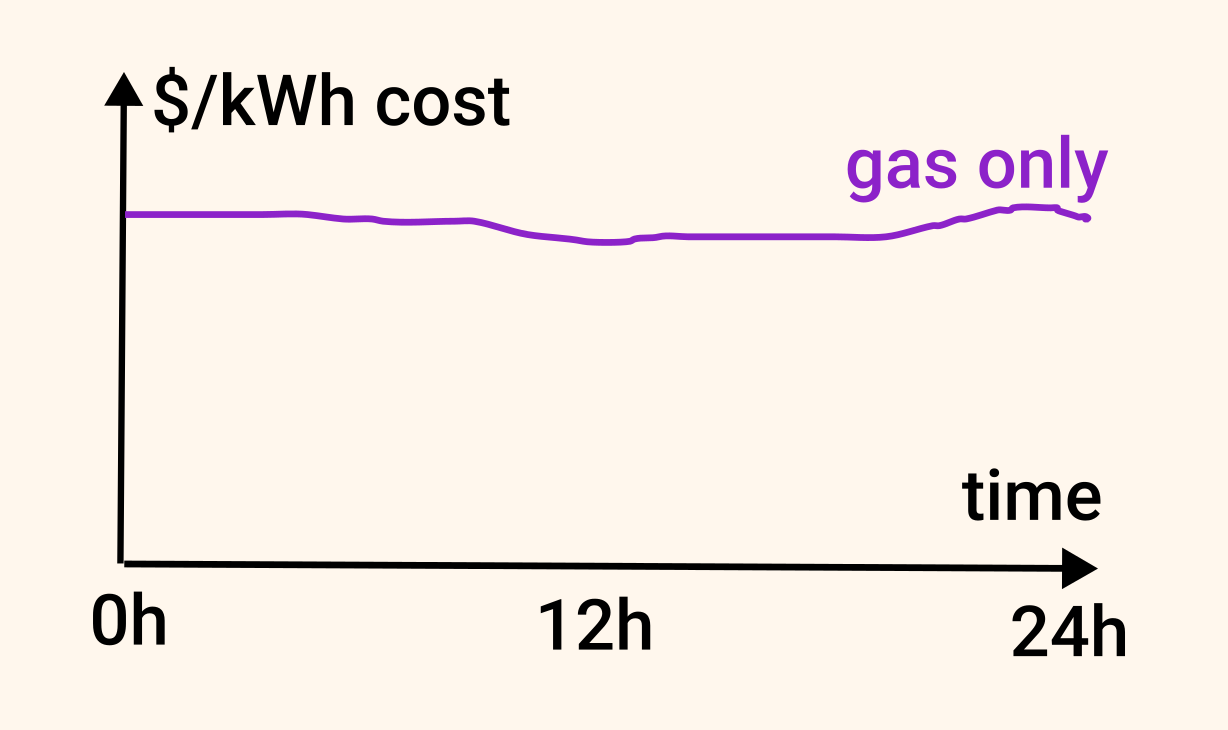
What happens to price as we start adding lots of solar to the grid?
Due to the bidding process of the energy markets, producers are incentivized to place bids to sell energy at the marginal cost of production.
The marginal cost of producing solar is basically zero, and thus, during peak solar production times, if there is enough solar during peak production hours, it can drive prices very low, sometimes to zero or below. (This again is a simplification, but the main point is true)
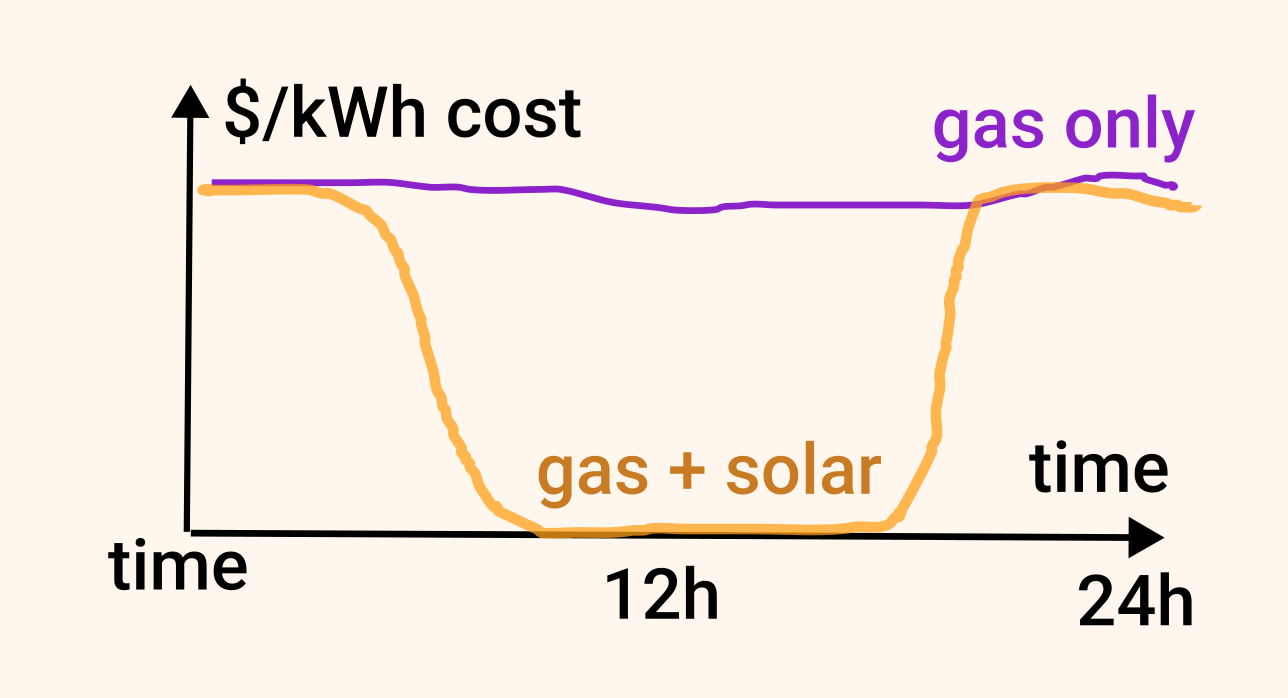
Given a sufficient amount of solar energy producers, this makes sense. this is also basically what we see in markets like Spain during the summer.
Thus, as one builds more renewables, one should expect that there will be a point that, even given renewables being extremely cheap, it still doesn’t make sense to buy more, since it would not be profitable.
And since we need more renewable energy, this is a market failure, and should find real solutions that work without markets.1
Broader points from the book
The video was inspired by, the book The Price Is Wrong: Why Capitalism Won’t Save the Planet, by Brett Christophers.
I tried to read it. Two comments.
First is that, sorry, but the writing style was not very good or entertaining or readable. But that’s besides the point.
The second, is that I actually end up mostly agreeing with the book, insofar as I understood it correctly, but I feel like it is arguing a subtly different point.
What was the point of the book?
The book’s central written to disavow the claims that Free markets alone will get us to renewables (and thus prevent climate change). This is a somewhat specific claim.2
I come out of this book. Yes, free markets are very valuable in making renewable energy cheaper and more viable, but that there are complications with building renewables. Yes, we may eventually get to the stage that the whole economy would get to renewables at some point through free markets alone, it probably wouldn’t be soon enough. Free markets do not price in the longer term effects sufficiently, and thus some level of government intervention is needed to accelerate the transition.
However, It’s not quite the case that the government can spend money once to accelerate the transition. Rather, spending money is better thought of as putting us further ahead in the curve of where we would be otherwise, and if the money stops, then so does progress until we reach that point again. If we want to reach a good end state, continuous government involvement is needed.
Conflating Problems
One aspect the author of the video seems to almost entirely miss, is that they are conflating a few different problems:
Markets underprice fossil fuels if carbon damages are not priced.
As more renewables come online, their market value can fall in the hours they all generate.
A low-carbon grid needs storage, transmission, flexible demand, interconnection, which is not priced into naive calculations of “price” or “profit”
When the market-split of renewables is low, storage is not that important to be viable or have much of an impact. When the market-split of renewables is high, you require complementary resources: storage, transmission, demand flexibility, interconnection, curtailment management, and likely some firm low-carbon power.
Yes, one can price in the base cost of generating the electricity, but a huge aspect of renewable energy is that it requires specific weather conditions.
Nobody wants to wait until the wind is blowing and the sun is shining to watch their tiktoks on their phone. There are significant social advantages to having most people consistently work the same office hours on the same schedule. These benefits of flexibility in other parts of life much out weight the slightly higher cost of electricity.
An energy market makes it explicitly clear, reflected in the price, that building more renewables without storage is close to saturation in some markets. Changing to a system that does not have energy prices determined through bidding, would still have many similar issues with renewables.
Yes, I do think government intervention is needed to make sure that these renewables and energy storage solutions built sooner rather than later. I agree that free markets left to their own devices may not do this fast enough. But the price in this situation is showing a real problem.
Additionally, the cost of energy storage has also gone down dramatically!
In some countries like Ireland, where I did an analysis about a year ago, the potential for payoff by adding more renewables is significant. 3
Overall I still find myself disagreeing with what this video got wrong. Yes, the key point about profitability vs price is true. But it’s collapsing several workable problems into one, and I don’t like that the video aims to push the viewer to vague solutions of socialist system change rather than tackling the problems directly
This post was written for day 12/30 of Inkhaven in a bit of a rush, and may have some minor errors that need to be fixed.
I guess I can understand how capitalism makes some problems more obvious, but a common solution people try is to fixing the price, but not the underlying problem that causes the price to be that way.
It’s been a while since I read the book, so I will need to look again to make this claim specifically.
There are still bottlenecks with D-TUoS energy market fees being inefficient, as well as issues with grid infrastructure being lacking and planning and grid connection taking a long time. But I will maybe write about this in a different post.