

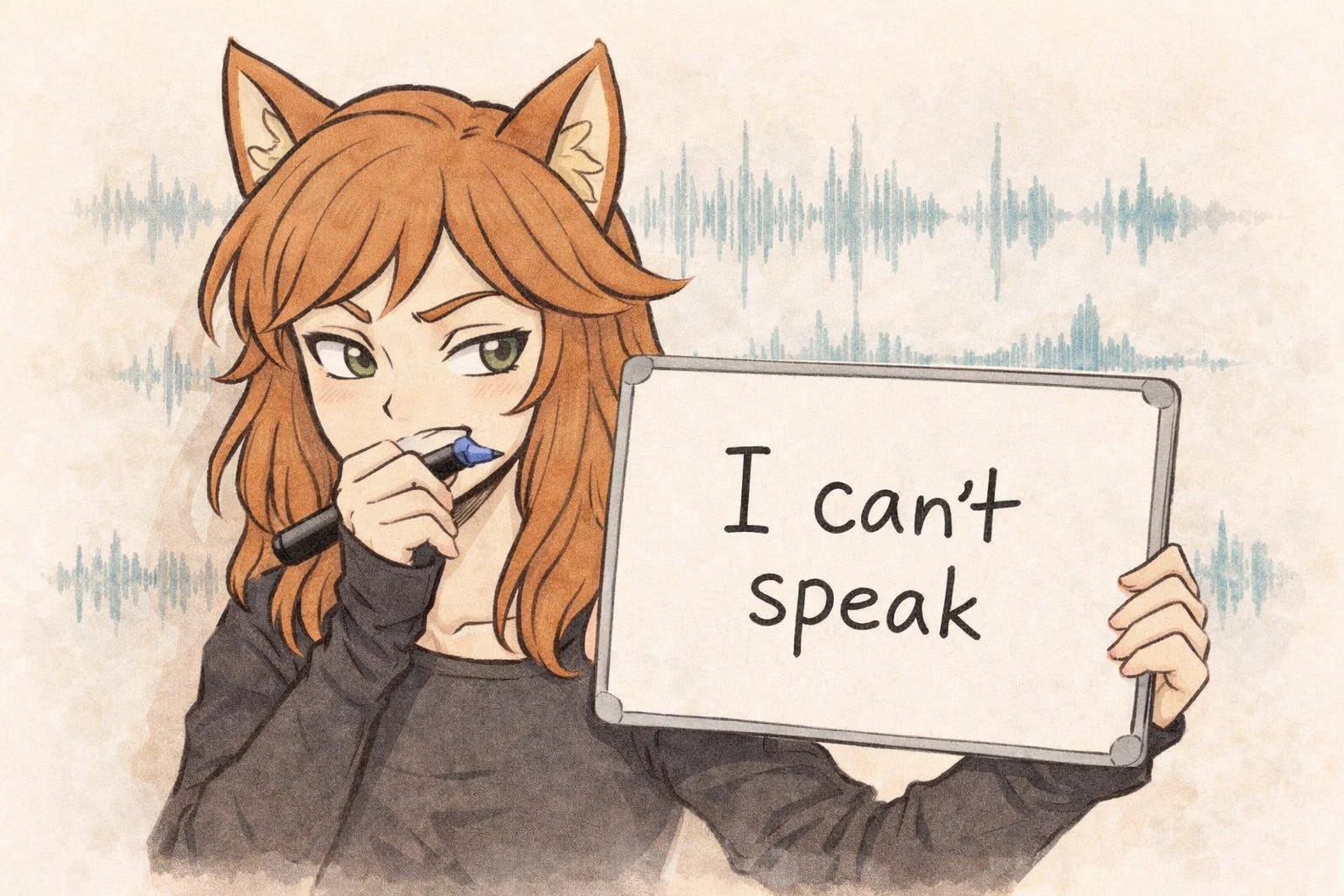
I am at a month-long social writing event, and unable to speak for most of it.
People are curious about what it’s like not being able to speak. I am happy to converse about it, but my bandwidth of communication is lower than usual, so I have written up some points about it here too.
The answers here are specific to me, I would guess that the answers would be different for other people who can’t speak.
Why can’t you speak?
I recently go voice surgery in Korea. My vocal chords were cut and reattached to alter my speaking profile.
I can technically speak. However the sutures holding my vocal chords together are small, they could come apart with too much stress, my vocal folds have not yet healed the wound. This could negatively impact results, and possibly require me to get revision surgery. I don’t want that to happen, so I follow the instructions.
A write-up of the surgery will be written elsewhere.
Side-note: It’s pretty interesting to watch a recording of your vocal chords, they do vibrate at a moderately large amplitude at a frequency in the ~low hundreds of Hertz. I can see why a wound there wouldn’t be healed easily.
How long can you not speak for?
Total recommended period is 8 weeks, and I have around 3 weeks left.
However, even when I will be able to speak, my voice will still be recovering from having been completely altered, so will be hoarse and weak for a while. (Technically I am in the phase where it’s OK to use like, 2 words per day, but it’s not a lot of bits of information so i don’t indulge on using them much.)
Can you hear me?
Yeah I can hear you.
(People sometimes assume I am also deaf, and maybe think I am lip reading. I guess reasonable assumptions to make on priors if all you know about me is that I can’t speak.)
Did you learn Sign Language?
No. I did intend to, and if I were wiser I probably would have, but I didn’t end up learning anything more than a small few basic things. A large part of this is because I didn’t have anyone to communicate in sign language with.
Additionally, I find it frustrating that for English, there are ISL, BSL and ASL, which are all quite different to each-other. If i were to choose one I would probably choose ASL despite spending much more time in Ireland and UK.
We did end up converging to making some non-standard signs for letters and such to communicate with my girlfriend, which we both find useful too.
How do you best prefer to communicate?
By far, i most prefer being able to sit down with my laptop with one person one-on-one, and talk to the other person by typing into my real-time TTS application
This is how i can get the most word-per-minute speed. It is still much slower than speaking, maybe by a factor of 2x. But just about OK that it still feels like a normal conversation.
Typing on my phone is faster than i would have thought, but i still don’t love it. Even in the best of times, it feels less like a conversation. Though part of this is because I usually reach for it while walking outdoors, and rain and cold make it hard to type. And part of this is because i just need to fix/replace my main phone which has a slightly cracked and broken touchscreen.
Otherwise when walking around, i find i prefer using a whiteboard and marker, though the speed of writing is much slower again, by about another factor of 2.
I might make a comparison of input speeds since I guess my intuitions didn’t quite match reality perfectly.
What about when you don’t have writing devices?
I find that if people are asking me questions, and i don’t have any writing devices, people can often infer a lot of information from very few bits.
Eg: if someone asks me a question with a number + units answer, showing numbers on my fingers is pretty easy, and they can guess what i mean, and I can give yes/no/kinda to convey some of the information.
Another good trick is people often ask a question with two possible outputs, and I give the number of which order answer is closest to my answer. However, people don’t tend to know this trick by default. Using other people’s in-built prediction models for likely outcomes is very useful.
For example: “Are you staying going to the social event, or to get lunch?” and I just gesture a “2” hand sign, and people are confused sometimes but it works pretty well. I can also gesture a “no” and try to gesture what i want to do, and they can come up with other hypotheses which i can yes/no. Sometimes I can gesture a letter (non-standard) and they can guess the word from it. Otherwise it’s time to bring out the writing tools.
Do you dislike it when I ask you questions with long answers?
No. If I have my writing tools, i generally quite like having interesting discussions, thinking about things, having one-on-one conversations.
I don’t personally mind needing to write, other than feeling some guilt that you might feel impatient waiting for me.
If you see me around Inkhaven and I’m on my own, please feel free to join me for a one-on-one!
Are there things you found particularly difficult?
Yeah.
I find group conversations to be really tricky. At the best of times, i don’t usually love group conversations anyway, but with the added delay of needing to write or type on my laptop, it feels like either I end up being the sole center of attention of the group with me answering questions, or i end up being basically ignored/locked out of the group conversation. I slightly prefer the former over the latter, but I don’t love either dynamic that much. (I guess with higher bandwidth communication like ASL + an interpreter this would mostly be solved, but I won’t be able to learn ASL to any significant fluency soon.)
I also do find it slightly frustrating when people ask me things, and i don’t have my TTS tools, and i try to write or gesture my answer, but they aren’t looking in my direction.
I also really like being able to go on walks and chat with people, so it’s quite annoying that I cannot easily chat with high bandwidth while I am walking. I also found while walking is when i would most easily be able to break off from the group and chat with people one-on-one so it’s doubly frustrating that way.
Otherwise idk, I guess I handle well being on my own and entertaining myself, I have a lot of things I want to read about or watch or listen to and play, so spending a month mostly to myself is pretty OK overall.
Are there any other restrictions?
Yeah, I’m supposed to avoid audibly laughing or coughing or sneezing or whispering or intense exercise or some periods of time too.
Additionally I am supposed to avoid things that would dry out my throat, such as caffeine (incl chocolate and coke) or strongly flavored foods.
How do you feel about it overall?
To be honest, i think it’s about similar to what I expected, maybe slightly worse in some ways. I basically modeled myself as being pretty resilient and not having any issues, but I did run into some, particularly with struggling to try to have group conversations. But I’ve also learned how to deal with it.
I also am like, generally someone who likes novel experiences even if they are "unpleasant”, just for the sheer novelty, and it has certainly been novel. There are various jokes that often appear and it has been fun capitalizing on those. It also at some points can feel kinda calm and relaxing to not feel like one has an obligation to speak (but maybe is counteracted when people don’t realize you can’t speak and think you are being rude). And generally people have been incredibly understanding so it’s been nice in that way.
I have also just learned to be slightly more expressive with my body to compensate for the fact that I can’t speak at all.
Overall, I think I am in some ways glad to have had the interesting experience, and think the results will have been worth it, but I still am looking forward to being able to just speak to people again.
If you have any other questions, ask away below!
what jokes appear?
Great post, explain what's going on and now more people will talk to you probably :)